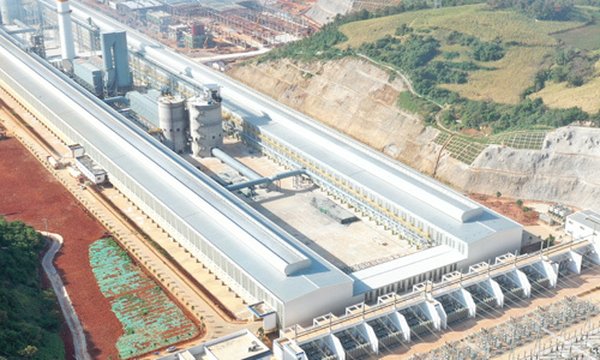
Calcium Silicate Insulation for Aluminum Smelter Engineers
Aluminum smelting presents a unique set of thermal management challenges. Hall-Heroult reduction cells operate at 950-980°C with a cryolite bath that chemically attacks most refractory and insulation materials. Molten aluminum at 750-800°C must be transferred in insulated ladles from reduction cells to cast house. Unlike steelmaking, where calcium silicate sits behind a relatively thick refractory lining, aluminum smelter applications demand insulation that resists direct aluminum contact and fluoride vapor penetration. Mingfa holds patented technology for non-stick aluminum calcium silicate boards, developed specifically for these conditions.
1. An Aluminum Smelter Engineer's Insulation Challenges
Aluminum smelter engineers face distinct insulation challenges that differ from other high-temperature industries:
- Cryolite attack. The cryolite-based electrolyte (Na3AlF6) in reduction cells is chemically aggressive. Fluoride vapors penetrate porous insulation, react with silica and calcium oxide, and cause volumetric expansion that cracks and degrades the insulation layer. Standard calcium silicate, which contains approximately 45% SiO2 and 43% CaO, is vulnerable to fluoride attack if not protected by a barrier layer.
- Molten aluminum wetting. Molten aluminum wets and penetrates most oxide-based ceramics including standard calcium silicate. When aluminum infiltrates insulation, it oxidizes in place (forming Al2O3), expands, and destroys the insulation structure. This is a concern for transfer ladles, launder troughs, and any application where insulation may contact molten aluminum directly.
- Heat balance control. A reduction cell must maintain a precise heat balance. Too much heat loss through the sidewalls freezes the cryolite bath and forms an excessively thick ledge; too little heat loss and the ledge melts, exposing the sidewall lining to direct bath attack. The insulation system must be engineered to maintain the correct thermal profile.
- Long service life. Reduction cells operate continuously for 5-8 years between major relines. Insulation that degrades prematurely forces an unplanned shutdown. The total cost of an early reline (lost production, labor, materials, and disposal) far exceeds the insulation material cost by a factor of 50-100x.
Key Takeaways
- Shell temperature reduction: Calcium silicate backup insulation reduces reduction cell shell temperatures by 30-60°C, maintaining structural integrity and extending cell life between relines.
- Fluoride resistance: Standard calcium silicate is vulnerable to cryolite vapor attack; always specify a barrier layer between the working refractory and calcium silicate in reduction cell sidewalls.
- 3-8% fuel savings: Proper insulation of transfer ladles and launder systems reduces heat loss during metal transfer, directly lowering energy consumption per tonne of aluminum produced.
- 14 patents: Mingfa’s non-stick aluminum calcium silicate technology (HCS-45NS) is backed by proprietary R&D — field-trialed at Chinese smelters with documented 80-90% reduction in aluminum infiltration versus standard boards.
Mingfa Lab Verified (2024): Performance data referenced on this page is validated through in-house testing at our Shandong facility per ASTM and EN test methods. 34+ years of continuous calcium silicate R&D since 1991. Quality assurance details
2. Where Calcium Silicate Fits in an Aluminum Smelter
Calcium silicate serves in several roles within an aluminum smelter, each with specific product requirements:
| Smelter Area | Application | Mingfa Product | Temperature Range |
|---|---|---|---|
| Reduction cell bottom | Insulation layer below cathode refractory | LG-Standard Board (HCS-23) | 200-500°C |
| Reduction cell sidewall | Backup insulation behind SiC sidewall | LG-High Temperature (SCS-25) | 300-700°C |
| Transfer ladle backup | Behind castable working lining | LG-High Density Non-Stick (HCS-45NS) | 200-600°C |
| Launder / trough backup | Behind refractory trough lining | LG-Standard Board (HCS-23) | 300-500°C |
| Cast house holding furnace | Backup behind working lining | LG-High Density (HCS-45) | 200-500°C |
| Anode baking furnace | Flue wall insulation | LG-High Temperature (SCS-25) | 500-900°C |
Sources: [1] ASTM C533-17(2023); [2] EN 14306:2015+A1:2018; [3] Manufacturer test data — Mingfa QC Laboratory, Laizhou, Shandong. Standards & certifications
3. Product Selection Guide
Product selection in aluminum smelting requires careful attention to chemical compatibility and mechanical requirements:
| Application | Recommended Product | Max Temp | Key Benefit |
|---|---|---|---|
| Cell bottom insulation | LG-Standard (HCS-23), 230 kg/m³ | 650°C | Compressive strength for cathode load, low thermal conductivity |
| Cell sidewall backup | LG-High Temperature (SCS-25), 250 kg/m³ | 1,050°C | Resists temperature excursions during anode effect |
| Transfer ladle (non-contact) | LG-Standard (HCS-23), 230 kg/m³ | 650°C | Standard board if protected by castable working lining |
| Transfer ladle (contact risk) | LG-High Density Non-Stick (HCS-45NS), 450 kg/m³ | 650°C | Non-wetting surface, resists aluminum penetration, one of Mingfa's patented technologies |
| Cast house furnace backup | LG-High Density (HCS-45), 450 kg/m³ | 650°C | Higher compressive strength for structural applications |
| Anode baking furnace | LG-High Temperature (SCS-25), 250 kg/m³ | 1,050°C | Low shrinkage at sustained high temperature |
About Mingfa's non-stick aluminum technology: One of the company's 14 patents covers a high-density calcium silicate formulation with surface treatment that resists wetting and penetration by molten aluminum at temperatures up to 800°C. This product (HCS-45NS) has been tested in transfer ladle backup applications and has shown substantially less aluminum infiltration compared to standard calcium silicate after equivalent service exposure. However, this product is a backup insulation layer, not a hot-face working refractory. It must still be protected by a castable or brick working lining for normal operation. The non-stick property is a secondary defense in case of working lining breach, not a replacement for a properly maintained working lining.
4. Real-World Results
Mingfa calcium silicate products have been supplied to aluminum smelters in the Middle East and Asia. In a Gulf-region smelter producing 600,000 tonnes per year, Mingfa LG-Standard board was used as the bottom insulation layer in reduction cell relines over a 3-year period. The cell bottom shell temperatures measured after reline were within 5°C of the temperatures achieved with the previous European-sourced insulation, at approximately 30% lower material cost.
In a Chinese aluminum smelter, Mingfa's patented non-stick high-density board (HCS-45NS) was trialed in 20 transfer ladles over 6 months. Post-trial inspection of ladles that experienced working lining cracks showed localized aluminum infiltration of 2-5 mm into the calcium silicate in 3 of 20 ladles, compared to full penetration (25 mm) observed with standard calcium silicate in the control group. The non-stick board was then adopted as the standard backup insulation for all 120 transfer ladles at the smelter.
These are site-specific results. Performance depends on working lining condition, operating temperature, and maintenance practice. Mingfa recommends that any new insulation product be trialed on a limited number of cells or ladles before full-scale adoption.
5. Technical Resources for Aluminum Smelter Engineers
- Calcium Silicate Product Range - density grades, non-stick options, custom dimensions
- Technical Resources - thermal conductivity curves, compressive strength at temperature, chemical analysis
- Insulation Thickness Calculation Guide - heat transfer modeling for multi-layer cell lining designs
- Technical FAQ - common questions about non-stick technology
- Mingfa's aluminum smelter projects in Yunnan Wenshan, Shenhuo, and Qingtongxia
6. Getting Started
To request a technical proposal for your aluminum smelter, prepare:
- Cell type and amperage (or cell dimensions for custom jobs)
- Application (cell bottom, sidewall, transfer ladle, launder, cast house furnace)
- Operating temperature and whether non-stick properties are required
- Working lining type and thickness above the insulation layer
- Current insulation specification (if replacing an existing product)
- Estimated annual consumption or reline schedule
Email lzmfgr@163.com for a technical recommendation and quotation. Samples of non-stick board are available for smelter trial evaluation.
Request an Aluminum Smelter Insulation Specification
Tell us your cell type and whether you need non-stick aluminum technology. We will specify the right product and provide samples for on-site trial evaluation.
Contact Mingfa Technical TeamAbout the Author — Mingfa Insulation Technical Team
Mingfa Insulation engineering team — 34+ years calcium silicate R&D and manufacturing since 1991. ~20 national patents. lzmfgr@163.com