How to Import Calcium Silicate Thermal Insulation from China: Logistics, Documentation, and Quality Assurance
Published: 2026-07-07 | By Mingfa Technical Team
Importing calcium silicate insulation from China offers procurement managers in the cement, steel, petrochemical, and aluminum industries access to a mature supply chain with significant cost advantages, provided the process is managed systematically. This guide covers the six phases of a typical import transaction: understanding the supply landscape, qualifying a manufacturer, negotiating commercial terms, managing container logistics, clearing customs, and inspecting the delivered material. It is written from the perspective of Mingfa Insulation, which has exported calcium silicate boards from Laizhou, Shandong since 1991, and contains operational data drawn from thousands of shipments across more than 40 countries.
China accounts for over 40 percent of global refractory and high-temperature insulation material production, concentrated in Shandong, Henan, Liaoning, and Jiangsu provinces. The raw material supply chain for calcium silicate is fully domestic: high-purity silica sand and limestone are quarried, processed, and consumed within regional industrial clusters. This vertical integration, combined with the scale of Chinese autoclave-based manufacturing, produces a price advantage of 30 to 50 percent compared to European and Japanese suppliers of equivalent ASTM C533-compliant board. Qingdao port, the primary export gateway for Shandong manufacturers, handles over 20 million TEU annually with container vessel sailings to every major industrial port worldwide.
1. Why Source Calcium Silicate Insulation from China
Key Takeaways
- Point 1: Chinese calcium silicate insulation costs 30-50% less than European equivalents on an FOB basis, with landed-cost savings of 20-35% for full-container shipments after freight and duties
- Point 2: Qingdao port offers freight rates 5-15% below Shanghai/Ningbo for Middle East, European, and African destinations, with transit times of 18-32 days to major industrial ports
- Point 3: Always verify suppliers via live video tour, third-party certifications (ISO 9001, EN 13501-1, ASTM C533), and batch-specific test certificates -- never rely on B2B platform profiles alone
- Point 4: Mingfa has exported calcium silicate boards from Laizhou, Shandong since 1991, holds ~20 national patents, and provides traceable batch documentation with every shipment
Author's Note: This article draws on Mingfa's 34+ years of calcium silicate R&D and manufacturing experience in Laizhou, Shandong. Technical claims are validated against our in-house laboratory data and published industry standards. About our engineering team
Sourcing calcium silicate insulation directly from Chinese manufacturers gives industrial buyers access to a vertically integrated supply chain where high-purity silica and limestone are processed into xonotlite-phase boards via autoclave synthesis, then exported through Qingdao port -- delivering 30 to 50 percent cost savings versus European or Japanese suppliers for ASTM C533-compliant material shipped to over 40 countries.
China's dominance in calcium silicate manufacturing is not solely a matter of labor cost; it reflects a structural advantage in raw materials, capital equipment, and cumulative production experience. Shandong Province alone hosts over a dozen autoclave-based calcium silicate producers, but only a handful of those specialize exclusively in calcium silicate rather than diluting production across multiple refractory product lines. A dedicated manufacturer such as Mingfa operates autoclave cycles tuned specifically for xonotlite-phase synthesis, with raw material formulations refined over decades of batch-level feedback, and CNC-machines custom shaped parts such as valve covers and flange insulation from cured board stock in its own plant. The 108,000-square-meter Mingfa factory in Laizhou runs multiple parallel autoclave lines, enabling production capacity of several thousand tons per month without cross-contamination from other product chemistries.
The logistics geography is favorable for most importing regions. Qingdao is approximately three hours by road from the Laizhou factory, and container freight rates from Qingdao are typically 5 to 15 percent lower than from Shanghai or Ningbo for Middle Eastern, European, and African destinations due to shorter inland transit and competitive carrier density. Transit times are predictable: 18 to 22 days to Jebel Ali (Dubai), 28 to 32 days to Rotterdam, 7 to 10 days to Singapore, and 20 to 25 days to Mombasa. For bulk project deliveries, charter vessel arrangements through Qingdao have been used for cargoes exceeding 500 tons, though the majority of calcium silicate insulation moves in standard 20-foot or 40-foot containers.
Cost comparison data from actual 2025 transactions bears out the advantage. A standard 600 mm by 300 mm by 50 mm board at 230 kilograms per cubic meter, Type II equivalent, typically prices at 18 to 28 USD per square meter FOB from Chinese manufacturers, depending on volume and density specification. Comparable material from European producers ranges from 30 to 45 USD per square meter, and Japanese-sourced boards often exceed 55 USD per square meter for the same ASTM C533 grade. The differential narrows once freight, duties, and local handling are added, but even on a landed-cost basis the Chinese material typically delivers a 20 to 35 percent saving for full-container shipments.
References: [1] ASTM C533-17(2023); [2] EN 14306:2015+A1:2018; [3] Mingfa QC Laboratory test data. Full certification details
2. Selecting and Qualifying a Supplier
The single most important decision in an import transaction is whether the supplier is a manufacturer or a trading company. The distinction matters because a trading company cannot control raw material quality, autoclave cycle parameters, or batch testing protocols. A manufacturer can produce mill test certificates from its own laboratory, hold inventory for rapid dispatch, and accept technical responsibility for product performance. In China's refractory industry, trading companies frequently register on B2B platforms with factory-sounding names, list multiple product categories spanning refractory bricks, ceramic fiber, and insulation boards, and source from whichever factory offers the lowest price on a given day. This model works for commoditized goods but creates risk for calcium silicate insulation, where density consistency and shrinkage performance depend on tight process control.
Minimum qualification criteria for a supplier should include: ISO 9001 certification (verify the certificate number on the issuing body's website, not just a scan on the supplier's own site), a valid export license (check the business license scope for “import and export of goods and technology”), and test reports conforming to the ASTM or EN standard relevant to your application. A manufacturer should also hold product-specific certifications: EN 13501-1 A1 classification for non-combustibility, ASTM C533 compliance, and ideally third-party test reports from SGS, Bureau Veritas, or TUV. Mingfa maintains all of these, plus approximately 20 Chinese national invention patents covering formulation and manufacturing process innovations, which are verifiable on the China National Intellectual Property Administration database using patent numbers such as ZL201410160342.X.
Specific red flags during supplier evaluation include: refusal to share batch-specific test data (generic brochures with “typical values” are not sufficient), no in-house laboratory visible during a video tour (a legitimate calcium silicate plant has a compression tester, guarded hot plate apparatus, muffle furnace for shrinkage testing, and density measurement equipment), unwillingness to provide reference customers in your region, and quotation turnaround that is either instant (suggesting a trader quoting from a price list) or unusually slow (suggesting the factory is disorganized). Verification steps that buyers should take: request a live video walk-through of the production line from raw material storage through autoclave to finished goods warehouse, ask for the factory's customs export records (a manufacturer can show consistent export volumes under its own name), and place a small trial order of 1 to 2 pallets before committing to container loads. Mingfa conducts factory video tours routinely for prospective buyers and maintains a list of reference customers in each major importing region, subject to confidentiality agreements.
3. Incoterms and Payment: FOB vs CIF vs EXW
The choice of Incoterm determines who bears freight cost, insurance, and risk at each stage of the journey from factory to destination. For calcium silicate insulation imports, three terms dominate practice. FOB Qingdao places responsibility on the supplier to deliver goods cleared for export and loaded aboard the vessel nominated by the buyer. The buyer controls the ocean freight contract and can negotiate directly with carriers or use a preferred forwarder. This is the most common term for experienced importers and typically yields the lowest total freight cost because the buyer shops rates rather than accepting the supplier's freight margin. The supplier's responsibility ends when the container crosses the ship's rail at Qingdao.
CIF to the destination port transfers freight arrangement responsibility to the supplier, who books the vessel and pays the ocean freight. The supplier's insurance covers the cargo to the named destination port, typically at 110 percent of the invoice value under Institute Cargo Clauses (C). This is simpler for first-time buyers who have no existing forwarder relationship or who want a single point of responsibility. The risk transfers at the destination port, not at the factory gate, so the supplier carries the marine transit risk. The trade-off is that the supplier will typically add a margin to the freight component, and the buyer has no direct relationship with the carrier if transit delays or container damage occur.
EXW (Ex Works) Laizhou means the buyer collects from the factory gate and handles all export formalities, domestic trucking to Qingdao port, export customs clearance, ocean freight, and destination-side logistics. This is the cheapest FOB-equivalent price but requires the buyer or their agent to manage Chinese domestic trucking and export declaration. EXW is practical only if the buyer has a China-based freight forwarder who can arrange factory collection and export processing. Typical payment terms across all three Incoterms: 30 percent telegraphic transfer deposit upon order confirmation, with the remaining 70 percent paid before shipment or against a copy of the bill of lading. For orders exceeding 100,000 USD, irrevocable letters of credit at sight are accepted by most established manufacturers, though L/C bank charges (typically 0.15 to 0.4 percent of the L/C amount) should be factored into the total cost. Mingfa's standard terms are 30/70 TT with B/L copy, with L/C at sight available for orders over 50,000 USD.
4. Shipping Calcium Silicate Boards: Container Logistics
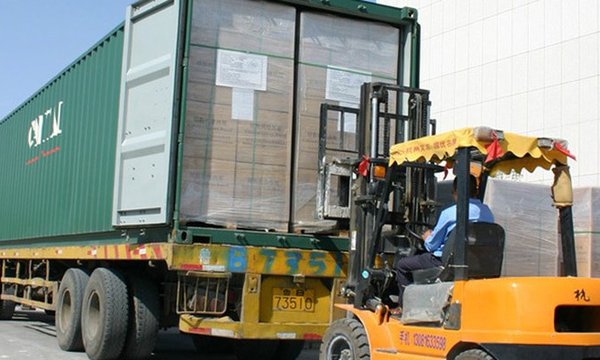
Calcium silicate boards present a specific set of container loading challenges: they are heavy for their size, rigid but impact-fragile at the edges, and moisture-sensitive before installation. Proper packing is not optional; a poorly packed container that arrives with chipped corners, cracked boards, or water-stained product represents a financial loss and a project delay. The standard export packing specification at Mingfa is: boards stacked on ISPM 15 fumigated hardwood pallets, wrapped in 0.15 mm polyethylene sheeting (waterproof, not just dust-protective), with 3 mm thick corrugated cardboard corner protectors on all pallet edges, secured by PET steel strapping in both directions at two levels per pallet. Each pallet is labeled with product grade, dimensions, quantity, batch number, and production date.
Container capacity depends on the board density and pallet configuration. A 20-foot GP container (internal dimensions approximately 5.90 by 2.35 by 2.39 meters) can carry approximately 28 standard pallets stacked to a height of 1.0 to 1.2 meters, for a total payload of roughly 25 metric tons before hitting the container weight limit. A 40-foot high-cube container (internal approximately 12.03 by 2.35 by 2.69 meters) holds approximately 56 pallets but is typically weight-limited to around 27 tons, meaning the extra volume of a 40HQ is only usable for lower-density board grades. For 230-kilogram-per-cubic-meter board, a 40HQ carries roughly the same weight as a 20GP despite nearly double the volume, so buyers ordering standard-density material often find the 20GP more cost-effective per ton shipped. High-density grades at 800 kilograms per cubic meter reach the weight limit with far fewer pallets.
LCL (less than container load) shipments are possible but introduce additional handling: the cargo is consolidated at a Qingdao CFS (container freight station), where it shares container space with other shippers' cargo and undergoes additional forklift movements. Each forklift transfer increases the risk of edge damage. For first-time trial orders of 2 to 3 pallets, LCL is acceptable, but project buyers should plan quantities to fill at least one 20GP. The standard Mingfa loading plan for a 20GP container uses three rows of pallets along the container length, with dunnage airbags inflated between rows to prevent shifting during transit. Lashing rings on the container floor are used to secure the base-layer pallets. Photographs of the loaded container with the doors open are provided to the buyer before the container is sealed and dispatched to Qingdao.
5. Customs Clearance and Import Documentation
Every shipment must be accompanied by a specific set of documents, and missing or incorrectly completed paperwork is the most common cause of customs delays. The minimum document set consists of: commercial invoice (showing seller, buyer, HS code, unit price, total value, Incoterm, and payment terms), packing list (pallet-by-pallet weight and dimensions plus total gross and net weight), original bill of lading or telex release (issued by the shipping line or freight forwarder), and certificate of origin. For shipments to ASEAN countries, Form E under the ASEAN-China Free Trade Area provides preferential tariff rates of 0 to 5 percent for calcium silicate products. For European Union destinations, Form A under the Generalized System of Preferences similarly reduces duty rates for Chinese-origin industrial materials. Certificate of origin applications require the manufacturer's business license, the commercial invoice, and, in some jurisdictions, a formal cost statement proving that the goods are substantially transformed in China.
The HS code for calcium silicate insulation board and pipe sections is 6806.90.0000, which covers “slag wool, rock wool and similar mineral wools; exfoliated vermiculite, expanded clays, foamed slag and similar expanded mineral materials; mixtures and articles of heat-insulating, sound-insulating or sound-absorbing mineral materials, other than those of heading 6811 or 6812 or of Chapter 69.” Import duty rates vary: most GCC countries apply 5 percent, the EU applies 0 to 3 percent depending on specific tariff line classification, and much of Southeast Asia applies 0 percent under AFTA/ACFTA. Importers in the United States should note that Section 301 tariffs on Chinese-origin goods may apply to HS 6806.90.0000 products, adding up to 25 percent to the CIF value before assessment of standard duties. A binding ruling request to US Customs and Border Protection can confirm the applicable rate before shipment.
Batch-specific test certificates are the document that most distinguishes a professional supplier from a commodity exporter. A batch test certificate should state: the batch number matching the pallet labels, the production date, the product grade and density specification, and the measured results for compressive strength (ASTM C165), flexural strength (ASTM C203), thermal conductivity (ASTM C177 or C518), linear shrinkage after 24 hours at rated temperature (ASTM C356), and density (ASTM C303). Generic certificates that list only “typical values” or that cite a batch number from six months earlier do not verify the material you have actually received. Mingfa issues batch certificates that are traceable to specific autoclave cycles and include the raw material lot numbers used in that production run. Additional documents that may be required for specific projects: fumigation certificate (if the destination country requires it, though ISPM 15 pallets already carry the fumigation stamp), manufacturer's declaration of conformity to ASTM or EN standards, and SGS or Bureau Veritas third-party inspection reports if pre-shipment inspection was contracted.
6. Receiving, Inspection, and Quality Dispute Handling
The moment a container arrives at the importer's warehouse is when quality problems become visible and when the clock starts for any formal claim. The first check should be made before the container doors are fully opened: look for signs of water entry (rust on door hinges, water marks on the floor), container structural damage (dents in the roof or side panels that may have transmitted impact to the cargo), and whether the container seal number matches the bill of lading. Photograph the seal before breaking it. Once the doors are opened, photograph the interior before unloading. Pallet wrap that is torn, water-stained, or collapsed indicates a problem during transit, and the photographs will support a marine cargo insurance claim if CIF terms were used.
During unloading, verify the quantity against the packing list pallet by pallet. Count the boards per pallet for at least 10 percent of the pallets; a legitimate supplier ships exact quantities, but miscounts do happen and should be reported immediately. Visual inspection covers board edges for chipping, board surfaces for cracking or delamination, and pallet stability. A single board with a chipped corner on one face is cosmetic and usually acceptable; widespread edge damage across multiple pallets suggests improper packing or rough handling and should be documented with photographs showing the pallet labels so the supplier can identify the production batch.
Dimensional and density spot checks provide quantitative verification. Measure the thickness of 10 randomly selected boards per pallet stack at the four corners and center using digital calipers accurate to 0.1 millimeter. Thickness tolerance for calcium silicate board per ASTM C533 is plus or minus 1.0 millimeter for boards up to 60 millimeters thick. Calculate the density of five boards by weighing each on a calibrated scale and dividing by the board volume (length times width times measured average thickness). Density tolerance should be within plus or minus 10 percent of the nominal value. For a more rigorous check, a 100 millimeter by 100 millimeter coupon cut from a sample board can be oven-dried at 110 degrees Celsius to constant mass for dry density determination per ASTM C303, but this requires laboratory equipment not always available at the receiving warehouse.
The claim process depends on the nature of the defect. Shipping damage (crushed pallets, water ingress, container impact) is a marine cargo insurance claim if CIF terms applied, or a claim against the carrier if FOB terms applied with the buyer's insurance. The key requirement is prompt notification: most marine insurance policies require written notice of loss within three days of delivery, and carriers typically require a joint survey within seven days. Quality defects (density out of specification, excessive shrinkage, low compressive strength) are claims against the supplier under the sales contract. A professional supplier will request photographic evidence, sample return of the defective material, and may dispatch a technical representative to inspect the cargo. Mingfa's standard contract terms provide for replacement of verified defective material or a pro-rata credit against the next shipment. Document everything: time-stamped photographs of the damaged or non-conforming material with the pallet label visible, measurement records, and correspondence with the supplier. A complete claim file assembled within 48 hours of container arrival resolves disputes far faster than scattered email threads.
7. 2026 Tariff and Compliance Landscape for Insulation Imports
Duty structures and documentation expectations shift continuously. As of 2026, the regional picture for calcium silicate insulation (HS 6806.90.0000) that importers should budget against is summarized below. These are general reference rates; the applicable rate for a specific shipment depends on the exact tariff line classification, origin documentation, and any trade-policy measures in force at the time of import, so confirm with your customs broker before committing to landed-cost calculations.
| Destination Region | Typical Duty Rate | Notes |
|---|---|---|
| GCC (UAE, Saudi Arabia, Qatar) | 5% | Uniform GCC common external tariff; certificate of origin required |
| European Union | 0-3% | Depends on tariff line; CE marking and EN 14306 documentation support customs review |
| Southeast Asia (ASEAN) | 0% | Form E under ASEAN-China FTA covers most calcium silicate products |
| United States | Up to 25% additional | Section 301 tariffs on Chinese-origin goods may apply on top of standard duties; request a binding ruling before shipment |
| Africa (various) | 0-10% | Varies by country; many African markets apply reduced rates for industrial project imports |
Beyond tariffs, two compliance themes are growing in weight for industrial insulation imports. First, batch traceability: buyers increasingly require the supplier's batch test certificates to be linked to specific autoclave cycles and raw material lots, not generic “typical values” documents, because project quality auditors and insurance assessors now ask for this chain of evidence. Second, environmental documentation: for projects in the EU and GCC, procurement specifications increasingly include a material declaration or carbon-footprint statement. Mingfa's batch certificates are traceable to autoclave cycle, and our sustainability and ESG page documents the manufacturing energy profile of calcium silicate production for teams compiling environmental submissions.
Practical checklist before the first shipment of a new supply relationship: confirm the HS classification with a binding ruling or broker opinion, verify the preferential certificate form required for your region (Form E for ASEAN, Form A where GSP applies), and archive the supplier's batch certificate template against your incoming-inspection procedure. Getting these three items right at the first order removes the most common causes of port-side delays.
Further Reading
- International Chamber of Commerce , Incoterms 2020 (ICC Publication No. 723E). Covers all 11 Incoterms rules with buyer/seller obligation tables.
- ASTM C533-17 , Standard Specification for Calcium Silicate Block and Pipe Thermal Insulation. Defines the physical and thermal property requirements that should be referenced in purchase orders.
- World Customs Organization , HS Nomenclature 2022 Edition, Heading 6806. Confirm the correct HS code classification with your local customs broker before the first shipment.
- International Plant Protection Convention , ISPM 15: Regulation of Wood Packaging Material in International Trade. Ensures pallets and crating meet phytosanitary requirements.
- China National Intellectual Property Administration (CNIPA) , Patent search database for verifying manufacturer patent claims.
- Laizhou Mingfa Insulation Materials Co., Ltd. , Product Technical Data Sheets and Calcium Silicate Insulation Board product page with standard specifications for export grades.
- Mingfa , Industrial Insulation Buying Guide for supplier evaluation criteria and specification comparison methodology.
- Mingfa , Custom Calcium Silicate Shaped Parts , prefabricated valve covers, flange insulation, and special shapes machined from CAD drawings.
- Saudi Arabia supplier page | UAE supplier page | India supplier page
Ready to source calcium silicate insulation from China?
Contact Mingfa for a quotation, batch test samples, and a live video tour of our Laizhou factory. We respond to export inquiries within one business day.
Request a QuotationAbout the Author — Mingfa Insulation Technical Team
Mingfa Insulation's technical content is authored by our in-house engineering team with 34+ years of specialized experience in calcium silicate R&D and manufacturing. Established in 1991 as a joint venture with the China Building Materials Academy, our team holds ~20 national patents. For technical inquiries, contact lzmfgr@163.com.